In the autumn of 1799, as revolutionary France convulsed under the Directory and the shadow of Napoleon lengthened across Europe, a 60-year-old economist named Pierre Samuel du Pont de Nemours made the decision that would alter the course of American industry. He gathered his two sons — Victor Marie and Éleuthère Irénée — and booked passage on the ship American Eagle, bound for the new republic across the Atlantic. They arrived on January 1, 1800, carrying little more than ambition, a Burgundian surname, and a working knowledge of chemistry that would prove more valuable than any fortune.
Pierre Samuel was no ordinary refugee. A physiocrat and confidant of Turgot, he had served as Inspector General of Commerce under Louis XVI, helped negotiate the Treaty of Paris that ended the American Revolution, and played a behind-the-scenes role in brokering the Louisiana Purchase — the largest land deal in history, which doubled the size of the young United States. His connections to Thomas Jefferson and the American founding generation were deep and genuine. But it was his younger son, Éleuthère Irénée, who would transform the family name from a footnote in French political philosophy into a byword for American industrial power.
"The DuPonts did not merely participate in the building of America — they supplied the gunpowder that cleared the forests, blasted the canals, and won the wars."
The Brandywine Mills
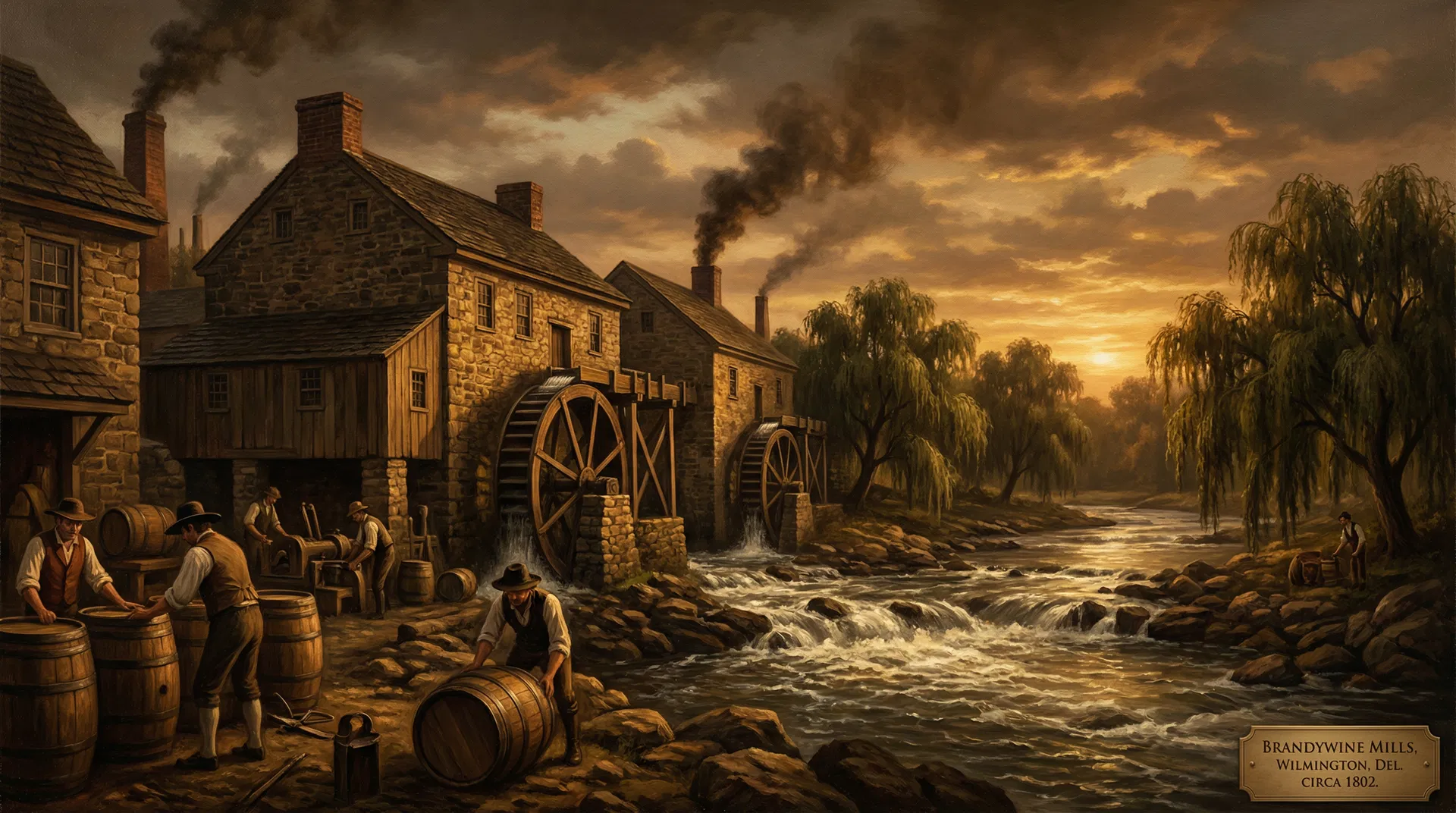
The Eleutherian Mills on the Brandywine River, where E.I. du Pont established America's first major gunpowder works in 1802.
In 1802, Éleuthère Irénée du Pont — known as E.I. — purchased 65 acres along the Brandywine River near Wilmington, Delaware, and built a gunpowder mill. He had studied under Antoine Lavoisier, the father of modern chemistry, at the French royal powder works, and he recognized that American gunpowder was vastly inferior to European standards. The opportunity was immense: a young nation expanding westward needed black powder for everything — clearing land, mining, construction, and defense.
Within a decade, E.I. du Pont de Nemours & Company was the largest gunpowder manufacturer in the United States. By the Civil War, the company supplied nearly half of all the Union Army's powder. The Brandywine mills ran continuously for over a century, and the profits from black powder — willow charcoal, saltpeter, and sulfur, combined with Lavoisier's precision — built the foundation of one of the most enduring family fortunes in American history.
Estates of an American Dynasty
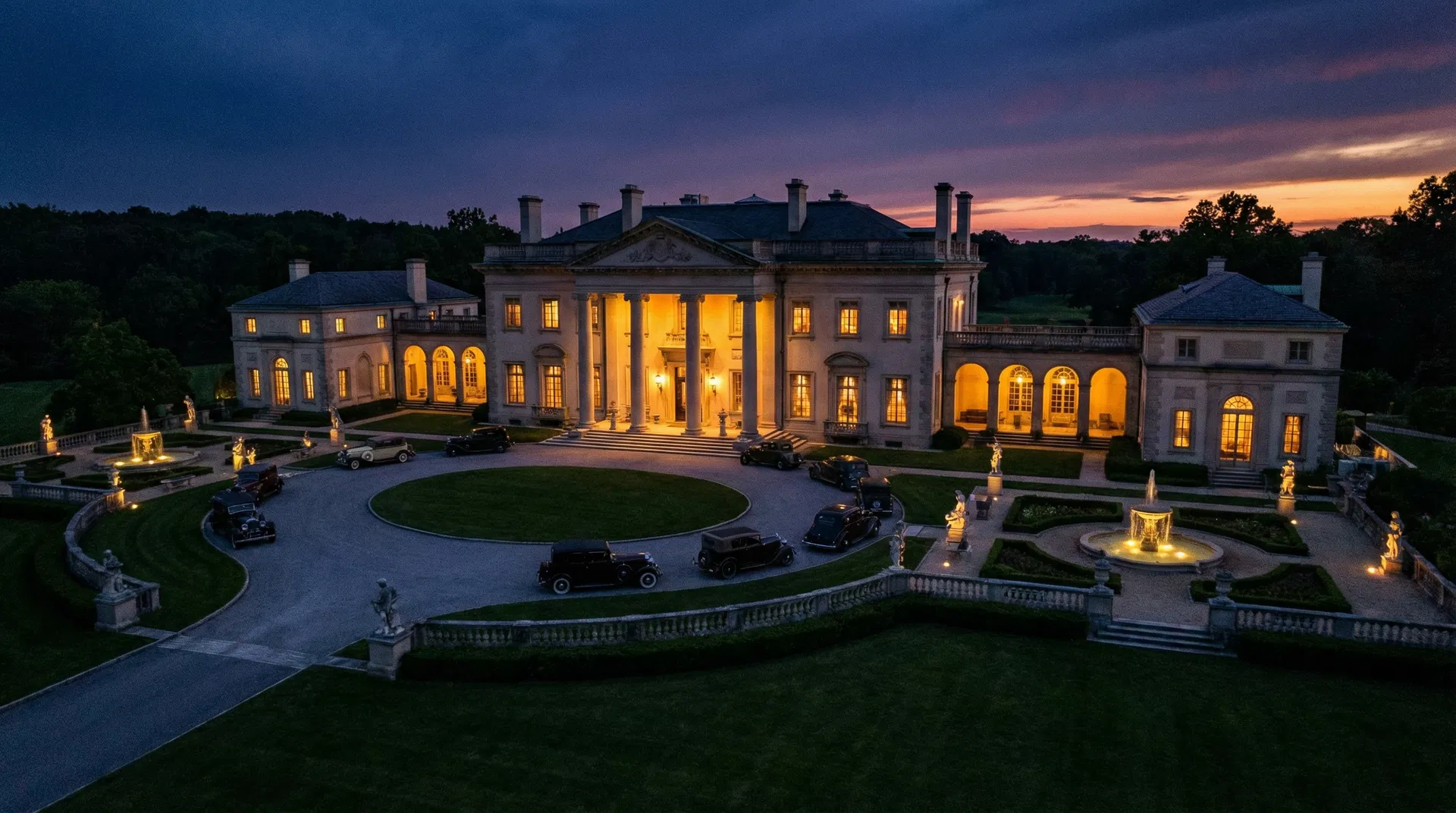
The grand estates of the DuPont family — from Winterthur to Nemours — stand as monuments to American aristocratic ambition.
As the fortune grew, so did the family's physical footprint on the Delaware landscape. The DuPonts built some of the most magnificent private estates in American history — a concentration of wealth and architectural ambition rivaled only by the Vanderbilts of Newport. Winterthur, the 175-room country estate of Henry Francis du Pont, became one of the premier museums of American decorative arts. Nemours, built by Alfred I. du Pont in the style of a French château, features 300 acres of formal gardens inspired by Versailles. And Longwood Gardens, the 1,077-acre horticultural paradise created by Pierre S. du Pont, draws over a million visitors annually and is considered one of the great gardens of the world.
The family's commitment to preservation extended beyond their own properties. DuPont family members helped found the National Trust for Historic Preservation and funded the restoration of President James Madison's Montpelier. In the Brandywine Valley, the DuPont name is not merely attached to buildings — it is woven into the landscape itself, a living testament to the idea that great wealth carries an obligation to stewardship.
A Legacy Written in Ledgers and Legislation

The DuPont influence extended far beyond industry and horticulture. The family sent two members to the United States Senate — Henry Algernon du Pont and T. Coleman du Pont — and wielded political influence in Delaware that was, for generations, essentially absolute. Pierre Samuel du Pont de Nemours himself had helped shape the Treaty of Paris and facilitated the Louisiana Purchase, and his descendants continued to operate at the intersection of commerce and statecraft for two centuries.
Today, Forbes ranks the du Pont family as the 22nd wealthiest in America, with an estimated fortune of $18.1 billion spread across approximately 3,500 living descendants. The family's influence spans finance, philanthropy, politics, motorsport (the DuPont Registry), and — through the company that still bears their name — the chemical and materials science industries that shape modern life.
From Gunpowder to Global Empire
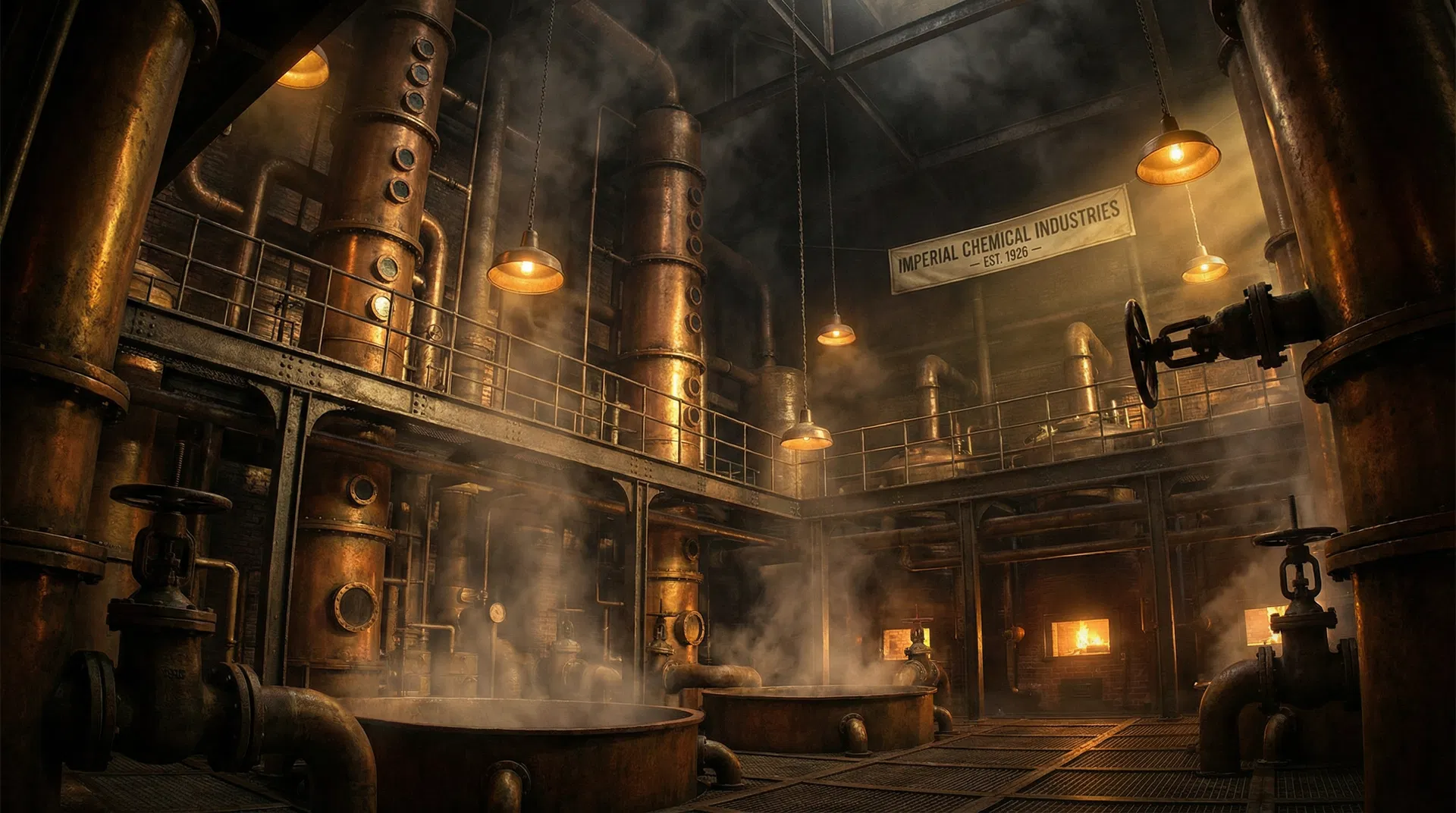
The transformation of DuPont from a gunpowder manufacturer into one of the world's largest chemical and materials science companies is one of the great pivots in corporate history. Under the leadership of Pierre S. du Pont in the early 20th century, the company diversified into dynamite, then into chemicals, plastics, and synthetic materials. The DuPont research laboratories became legendary, producing a string of inventions that reshaped daily life: Nylon (1935), Teflon (1938), Kevlar (1965), and Tyvek (1967), among dozens of others.
At its peak, the DuPont company employed roughly 10 percent of Delaware's entire population. The family's corporate motto — "Better Things for Better Living, Through Chemistry" — became one of the most recognized slogans in American business. The company's influence on the 20th century is difficult to overstate: DuPont materials went into everything from women's stockings to bulletproof vests, from space suits to house wrap.
A Name That Carries Weight
DuPont's Rare American Bourbon is crafted in the spirit of a dynasty that helped build America — a small-batch tribute to heritage, patience, and uncompromising quality. Every bottle carries the weight of two centuries of distinction. From the Brandywine to the barrel room, the name DuPont has always meant one thing: the relentless pursuit of something finer.
View Investor Deck →